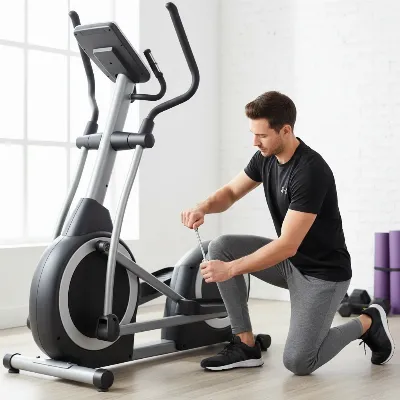
Has your trusty elliptical trainer started making strange grinding noises, developed an inconsistent stride, or perhaps even stopped moving altogether? Don’t let a sluggish or silent machine derail your fitness goals. Often, the culprit behind these issues is a worn or broken drive belt, a vital component that powers your elliptical’s smooth motion. Before you consider shelling out for professional repairs or even replacing your entire machine, know that replacing the drive belt is a perfectly achievable DIY project. This comprehensive guide will walk you through every step, empowering you to restore your elliptical to its former glory and get back to your workouts with confidence.
Understanding Your Elliptical’s Drive Belt and When to Replace It
The drive belt is the unsung hero within your elliptical trainer, connecting the flywheel to the crank mechanism and enabling the pedals and handlebars to move in sync. It’s a crucial link in the chain that delivers resistance and ensures a fluid, low-impact workout. Without a properly functioning drive belt, your elliptical simply won’t perform as intended, if at all.
What is the Elliptical Drive Belt?
|
Our Picks for the Best Elliptical Trainer in 2026
As an Amazon Associate I earn from qualifying purchases.
|
||
| Num | Product | Action |
|---|---|---|
| 1 | Cubii JR1, Under Desk Elliptical, Under Desk Bike Pedal Exerciser, Seated Elliptical, Work from Home Fitness, Mini Elliptical Machines for Home Use, Cubii Exerciser for Seniors, Desk Exercise |

|
| 2 | JLL Smart Mini Elliptical – Low-Impact Cardio, Quiet Magnetic Resistance (8 Levels), Compact for Home or Office, LCD Display, Bluetooth SunnyFit App Compatible |
|
| 3 | Under Desk Elliptical Machine, Electric Elliptical as Seen on TV for Seniors Adults with 15 Adjustable Speed, Quiet & Portable Electric Seated Pedal Exerciser with Remote Control & 5 Auto Mode |
|
| 4 | Under Desk Elliptical Machine, Electric Elliptical Leg Exerciser for Seniors Fully Assembled, Quiet & Portable Electric Seated Pedal Exerciser with Remote Control & 12 Adjustable Speeds |
|
| 5 | Under Desk Elliptical Machine, Electric Elliptical Leg Exerciser While Sitting for Seniors with Upgraded 15 Speeds & 12 Auto Mode, Forward & Reverse Direction, Quiet Portable Seated Pedal Exerciser |
|
| 6 | Elliptical Exercise Machine for Apartments and Homes,8 Levels of Magnetic Resistance,15.5-inch Stride Elliptical Machine, and Supports Users up to 400 pounds Elliptical Training Machines; |
|
| 7 | Under Desk Elliptical Machine, Upgraded 6 Adjustable Resistance &15 Speeds Electric Elliptical Leg Exerciser while Sitting for Seniors with Forward & Reverse Direction, Touch Screen and Remote Control |
|
| 8 | Under Desk Elliptical Machine, Electric Seated Pedal Exerciser, Min Leg Exerciser with Remoter, 12 Level Speeds, Forward & Reverse Direction, Manual & Auto Mode for Home Office |
|
| 9 | Under Desk Elliptical Machine, Electric Ellipse Leg Exerciser for Senior, Quiet and Compact Electric Seated Pedal Exerciser for Home with Display Monitor, Remote Control and 12 Adjustable Speeds |
|
| 10 | Sunny Health & Fitness Cardio Climber Stepping Elliptical Exercise Machine for Home with 8 Levels of Magnetic Resistance, Performance Monitor, Full Body Workout |
|
At its core, an elliptical drive belt is a heavy-duty, multi-ribbed rubber or synthetic belt designed to transmit power efficiently and silently. It wraps around a series of pulleys and the flywheel, creating the resistance you feel during your workout. Its robust design is engineered to withstand significant force and repetitive motion, but like all mechanical parts, it has a finite lifespan. 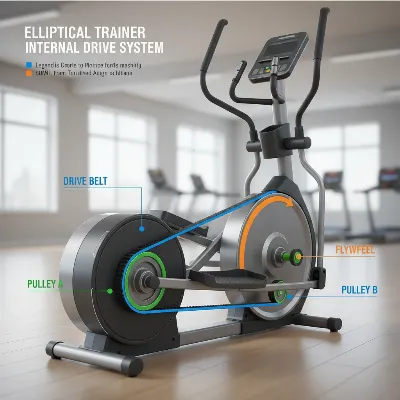 Anatomy of an elliptical trainer's drive system with the drive belt highlighted
Signs of a Worn or Broken Drive Belt
How do you know if your drive belt is the problem? Several tell-tale signs indicate it’s time for a replacement. The most common symptom is a slipping sensation, where the pedals move but the flywheel doesn’t engage smoothly, especially under higher resistance. You might hear grinding, squealing, or flapping noises coming from inside the machine as the belt struggles. In more severe cases, if the belt has completely snapped, the pedals will offer no resistance and may move freely without engaging the flywheel at all. Visually, you might notice cracks, fraying, or even missing sections on the belt itself if you can access it.
Why DIY?
Undertaking a DIY drive belt replacement offers significant advantages. Primarily, it can save you a considerable amount of money on service call fees and labor costs that a professional technician would charge. It also provides a valuable opportunity to understand the mechanics of your fitness equipment better, potentially simplifying future maintenance or repairs. With patience and the right guidance, this project is well within the capabilities of most home users.
Essential Tools and Materials for Drive Belt Replacement
Before you begin, gathering the correct tools and the right replacement belt is paramount. Having everything on hand will streamline the process and prevent frustrating interruptions. Safety should always be your first priority when working with electrical appliances and moving parts.
Required Tools
Most elliptical trainers use standard fasteners, meaning you likely have many of the necessary tools already. You’ll typically need a set of Phillips head and flathead screwdrivers for removing various covers and panels. A set of hex keys (Allen wrenches) will be essential for detaching pedal arms, upper body arms, and other bolted components. An adjustable wrench or a set of open-end wrenches may also be required for specific nuts and bolts, particularly for tensioning mechanisms. In some instances, if a pedal or crank arm is particularly stubborn, a gear puller might be necessary, which can often be borrowed from an automotive store. 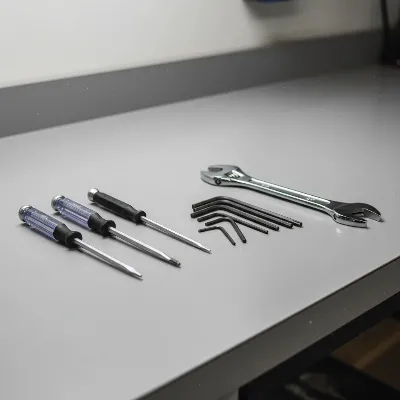 Essential tools for replacing an elliptical drive belt laid out on a workbench
New Drive Belt
Acquiring the correct replacement drive belt is crucial. The best way to ensure compatibility is to check your elliptical’s user manual or look for a label on the existing belt. The label usually contains a series of numbers and letters (e.g., 380J12, 10PJ813), which indicate the belt’s length and number of ribs. If the label is worn, you might need to refer to your elliptical’s model number and brand to search for the specific part online. Purchasing from the manufacturer or a reputable fitness equipment parts supplier is recommended to ensure quality and fit.
Safety First
Always, without exception, unplug your elliptical trainer from the power outlet before you begin any repair work. This eliminates the risk of electric shock and prevents the machine from accidentally starting. Clear your workspace of any clutter to avoid tripping hazards and ensure you have enough room to maneuver. You may also consider wearing gloves to protect your hands from grease or sharp edges.
Step-by-Step Guide to Replacing Your Elliptical’s Drive Belt
Replacing your elliptical’s drive belt involves a series of logical steps, starting with careful disassembly and ending with precise reassembly. Take your time, document your steps, and keep track of all fasteners.
Disassembly – Gaining Access
Your goal in this phase is to expose the drive system and the old belt. Begin by unplugging the machine. Next, you’ll typically need to remove the upper body arms. This usually involves using a hex key to loosen and remove bolts connecting the upper arms to the pedal arms. Be cautious as these arms may swing freely once detached. Following this, remove the pedal arms from their connections to the crank or discs. This might involve a hex key or a wrench, and some models might require removing plastic covers over the pedal discs first. 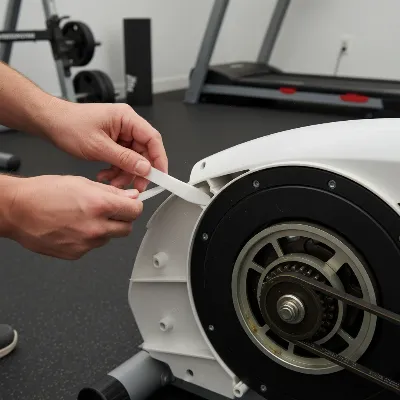 Hands carefully removing the side cover of an elliptical to access internal components
Once the arms and pedals are free or moved aside, you’ll need to remove the plastic side shields and covers that enclose the drive system. These are usually secured with Phillips head screws or sometimes snap-on clips. Work methodically, saving all screws and parts in a logical order, perhaps in small labeled containers, to simplify reassembly. Many units feature multiple covers—top, side, and lower shields—all of which might need to be removed for full access.
Removing the Old Belt
With the covers off, you’ll see the intricate network of pulleys, the flywheel, and the drive belt itself. Before removing the old belt, take a moment to observe its routing path. Taking a photo with your phone can be immensely helpful for reference during installation. Next, you’ll need to loosen any tensioner mechanisms that hold the belt tight. This could be an idler pulley with an adjustment bolt and a pivot bolt, or a resistance cable connected to an eddy mechanism. For ellipticals with a resistance motor and eddy mechanism, you might need to disconnect a tension cable from the motor to create slack. Once loosened, you can carefully “walk” the old belt off the pulleys and remove it.
Installing the New Belt
Now it’s time to install the replacement belt. Following the routing path you observed earlier, begin by placing the new belt around the largest pulley, typically the flywheel pulley. Then, systematically route the belt around the remaining pulleys and idler wheels. Ensure the ribbed side of the belt correctly engages with the grooves on the pulleys. This step often requires some patience and gentle manipulation to get the belt fully seated. 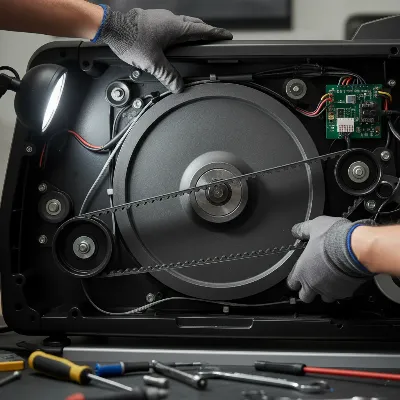 A new drive belt being carefully routed around the pulleys and flywheel of an elliptical
Tensioning the New Belt
Proper belt tension is critical for optimal performance and longevity. If your elliptical has a tensioning mechanism (like an idler pulley with adjustment bolts), you will need to tighten it to apply the correct tension to the new belt. A correctly tensioned belt should have a slight give when pressed but should not feel loose or easily slip when the unit is pedaled. If your model uses a resistance motor and eddy mechanism, reconnect the tension cable to the resistance motor, ensuring it’s properly seated. “Don’t overlook the importance of proper belt tension. Too loose, and it will slip; too tight, and it can strain components, leading to premature wear. A correctly tensioned belt ensures smooth, efficient operation,” advises Mark Jenkins, Founder of GymTech Repair. 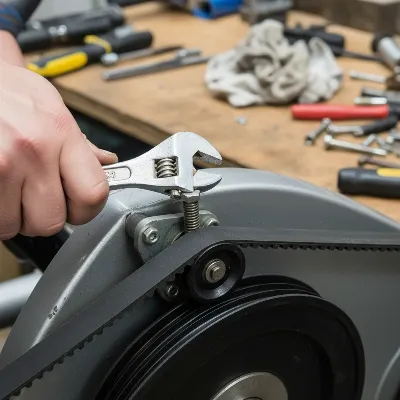 A person adjusting the tensioner mechanism on an elliptical drive belt
Reassembly – Putting It Back Together
Once the new belt is installed and correctly tensioned, the final phase is reassembly. This is essentially the reverse of your disassembly steps. Carefully reattach all covers, side shields, pedal arms, and upper body arms. Ensure all screws, bolts, and clips are securely fastened. Double-check that no tools or stray parts are left inside the machine. Once fully reassembled, plug the elliptical back in and test its operation. Pedal slowly at first, listening for any unusual noises and checking for smooth, consistent resistance. “The key to a successful drive belt replacement lies in understanding your machine’s specific design and meticulously following the steps for disassembly, belt routing, and tensioning. Patience is your best tool,” states Dr. Alex Thorne, Sports Biomechanics Expert.
Troubleshooting and Preventative Maintenance
Even after a successful replacement, a little troubleshooting and ongoing care can ensure your elliptical continues to perform flawlessly.
Common Issues After Replacement
- Belt Slipping: If the new belt slips, it’s likely still too loose. Re-open the covers and adjust the tensioner further.
- Noise: Rattling or grinding noises could indicate that a cover isn’t fully secured, or perhaps a component wasn’t reattached correctly and is rubbing. A squealing noise might mean the belt is slightly misaligned or too tight.
- Incorrect Resistance: Ensure any resistance cables or mechanisms disconnected during the process are correctly reattached and calibrated according to your manual.
When to Call a Professional
While drive belt replacement is a common DIY task, there are times when professional help is advisable. If you encounter unexpected complex wiring, seized bolts, or if your elliptical’s specific design is vastly different from common models and proves too challenging, it’s wise to seek a certified technician. Don’t risk further damage to your machine or personal injury if you feel out of your depth.
Extending Your Drive Belt’s Life
To get the most out of your new drive belt and prevent premature wear, incorporate some simple maintenance into your routine. Regularly clean the internal area around the belt and pulleys to remove dust, dirt, and pet hair that can cause friction and wear. Avoid overloading your elliptical beyond its recommended weight capacity, as this puts excessive strain on the drive system. Lastly, ensure you use the machine with proper form, as uneven pressure can sometimes contribute to belt stress. “Replacing your elliptical’s drive belt might seem daunting, but with the right tools and a methodical approach, it’s a perfectly achievable DIY task that can save you significant repair costs,” notes Sarah Chen, Certified Fitness Equipment Technician. 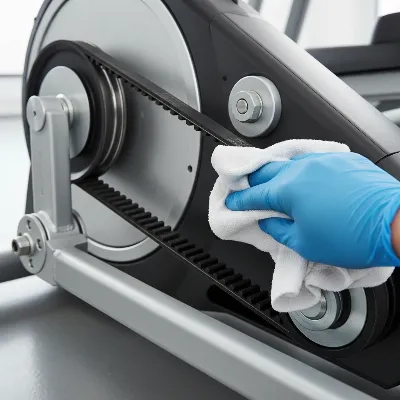 Cleaning an elliptical drive belt and pulleys to prevent premature wear
Conclusion
A broken drive belt doesn’t have to spell the end for your Elliptical Trainer. By following this detailed guide, you can confidently tackle the replacement yourself, saving money and gaining a deeper understanding of your fitness equipment. Remember to prioritize safety, gather the right tools, and work methodically through each step, from disassembly to tensioning and reassembly. With a little patience and effort, you’ll soon have your elliptical running smoothly again, ready to power many more effective workouts. Why not empower yourself with the knowledge to keep your home gym equipment in top shape?
Câu Hỏi Thường Gặp
How often should an elliptical drive belt be replaced?
The lifespan of an elliptical drive belt varies widely depending on usage frequency, intensity, and the quality of the belt itself. For a home elliptical used regularly, a belt might last anywhere from 3 to 7 years. Heavy commercial use could necessitate more frequent replacement, while light occasional use might extend its life significantly beyond that range.
Can I use any drive belt as a replacement?
No, you must use a drive belt that matches the specifications of your elliptical’s original belt. This typically includes the length, width, and number of ribs (e.g., 380J12, 10PJ813). Using an incorrect belt can lead to poor performance, further damage to your machine, or even be unsafe. Always consult your user manual or the existing belt’s label for the correct part number.
What if my elliptical doesn’t have a tensioner?
Some elliptical models are designed with a fixed drive system that doesn’t include an adjustable tensioner. In these cases, the belt’s fit is inherently designed to be snug. Replacing the belt might involve stretching it slightly to fit over the pulleys. If you encounter this, carefully follow your specific model’s instructions, as improper installation can damage the belt or machine.
Why is my new belt slipping?
A new belt slipping typically indicates that it is not properly tensioned. Re-check the tensioning mechanism and tighten it further until the belt feels firm with only a slight amount of give when pressed. Ensure the belt is correctly seated in all pulley grooves and that any idler pulleys are making proper contact.
Is it dangerous to replace an elliptical belt myself?
Provided you follow proper safety precautions, replacing an elliptical belt yourself is generally safe. The most crucial step is to always unplug the machine from the power source before starting any work to prevent electrical shock or accidental machine activation. Being mindful of moving parts during reassembly and using the correct tools will further ensure a safe repair.